
02 Nov. German Employment Contract: What To Read Before You Sign
A German employment contract is not a formality to sign quickly. It is the written version of the deal you thought you had, and several clauses determine how much control you actually have over your job, your time and your exit.
Many international professionals receive the contract after weeks of interviews, feel relieved that the process has finally moved, and read it mainly for the salary.
That is understandable. It is also where problems begin.
The contract does not only confirm that you got the job. Instead, it defines your role, your working time, your pay, your notice period and, in some cases, your options after you leave.
Why German Contracts Feel Different
German employment contracts are often longer, more formal and more detailed than contracts in other job markets. That is not necessarily a sign that an employer is being difficult.
German employers operate in a system where formal wording, documentation, works-council involvement and internal classification matter. As a result, contracts can contain clauses that look excessive, vague or overly legalistic to someone used to a shorter employment document.
The useful question is not: “Is this normal?”
The better question is: “What does this clause actually do to my role, my time, my money and my options?”
Two Pieces Of Advice That Fail
Online advice usually pushes people towards one of two extremes.
“It Is Standard German Contract Language. Just Sign It.”
That sounds reassuring, especially when it comes from HR, a recruiter or a colleague. But “standard” does not mean “non-negotiable” or “legally watertight.”
Variable-pay targets, remote-work arrangements, overtime rules, relocation support and the description of your actual role are often customised. Furthermore, employers also reuse templates, and some contain wording that no longer reflects current case law.
“Question Every Line. Never Sign Without A Lawyer.”
The opposite advice is usually imported from a more adversarial negotiating culture. In Germany, treating every clause as a battlefield can waste goodwill before your first working day.
Most contracts contain standard clauses that are unremarkable. The useful skill is knowing which clauses deserve attention, and what a precise question sounds like.
The problem is not that German contracts are full of traps. The problem is that they are written for a system where formal wording, internal processes and documentation matter more than many international candidates expect.
A Practical Example: Camila’s Contract
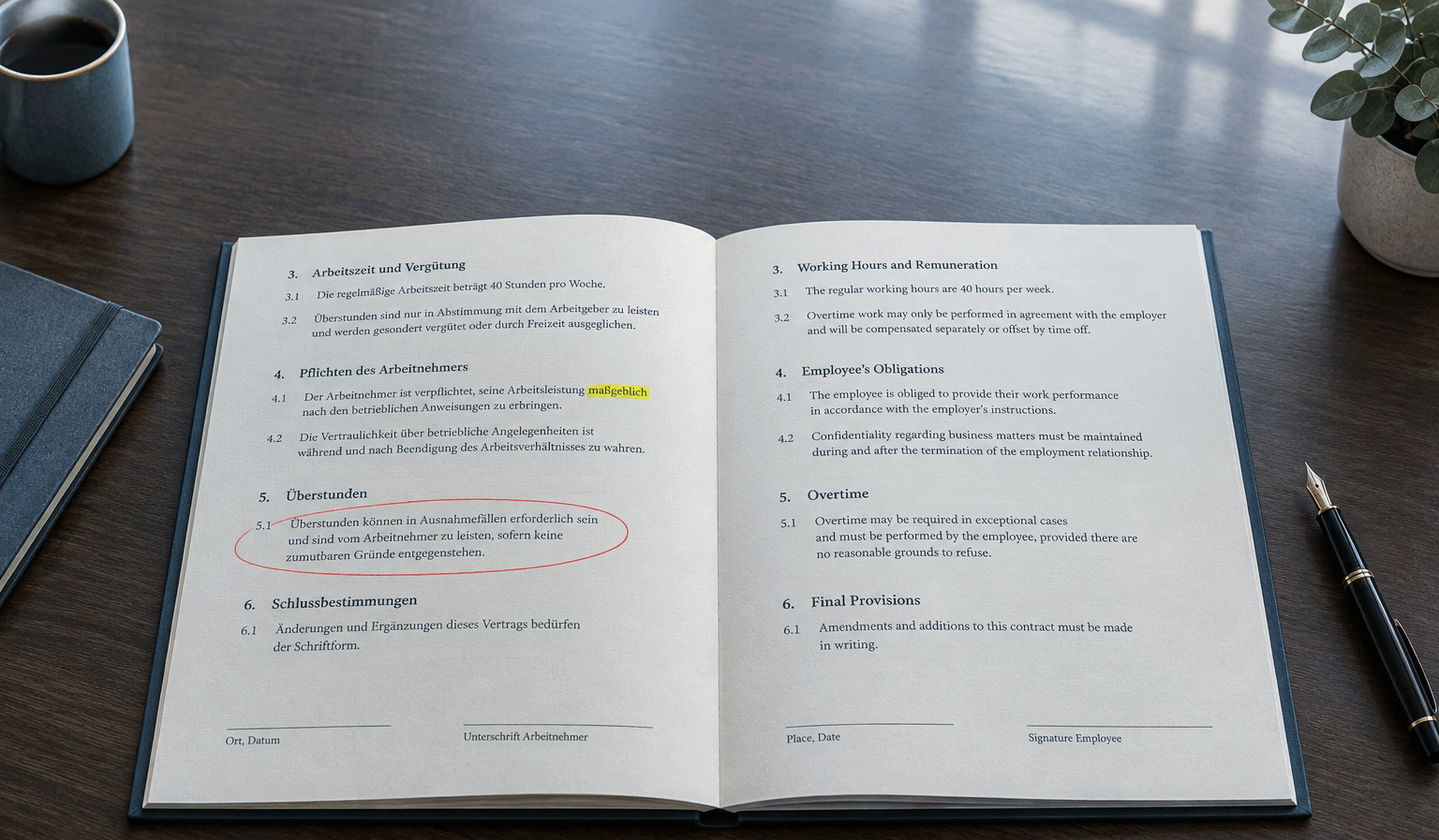
Camila is a civil engineer from Argentina. After a successful process with a German infrastructure company, she received a dual-language employment contract: German on the left, English on the right.
The salary looked right. The start date was clear. The job title was close enough to the role she had interviewed for. Her first instinct was to sign and move on.
Instead, she looked for one word first: „maßgeblich“.
It appeared in a clause explaining that, if the German and English versions differed, the German version would prevail. That did not make the contract suspicious. But it changed how she read it.
She could not treat the English version as the full agreement. Therefore, she needed to understand the German wording, or at least know which sentences mattered most.
She then noticed something else. The contract mentioned overtime, but did not clearly limit uncompensated overtime or explain how it would be recorded. It was not necessarily a disaster. It was an open question.
Camila asked one factual question before signing: how overtime was handled in practice, and whether there was an internal limit or approval process.
The answer did not transform the contract. But it gave her a clearer picture of the job she was accepting.
That is the realistic value of reading a contract properly. It does not always produce a dramatic negotiation. Ultimately, it helps you sign with fewer assumptions.
Read A German Employment Contract In This Order
Do not read a German employment contract from the first page to the signature line. Read it in the order that reveals the parts most likely to affect your working life.
1. Which Version Controls?
If the contract is bilingual, find the clause that says which language version prevails. Look for „maßgeblich“.
This matters because translated contracts can differ in tone, wording or detail. The German version may be the one a German court or authority would read first.
You do not need to translate every sentence yourself. But you should know which version is authoritative.
Also check whether the contract refers to annexes, company policies, a collective agreement or later amendments. Those documents can become part of the deal.
2. What Role Are You Actually Hired For?
Look at the job title, the Tätigkeitsbeschreibung and any internal grade or job category.
This is where the administrative title swap happens. You may interview for a clearly defined role, then receive a contract built around a broader internal category, with a generic title and wide wording about your duties.
This is not always a bait-and-switch. German employers often work with internal salary bands, works-council job categories, collective-agreement classifications or legacy HR templates. The contract may reflect an administrative bucket rather than the conversation you had with the hiring manager.
But the consequence for you is real. If the written role is vague, the employer has more room to define your work after you start.
A practical request is not: “Rewrite my contract.”
It is: “Could you confirm in the contract that my functional role is [X], while the internal grading remains [Y]?”
That separates the job you are doing from the internal category used for administration.
3. What Does The Employer Control?
Look for a Versetzungsklausel, a clause allowing the employer to assign different tasks, teams or locations.
Such clauses are common. Employers need some flexibility to organise work. The question is not whether the clause exists, but how broadly it is written and how precisely your actual role is described.
A contract that says you are hired as a grid-connection engineer, with a defined project focus, gives you a different practical position from one that says you are hired as an “engineer” and can be assigned other suitable tasks.
You do not need to reject flexibility. You need to understand its likely limits.
4. What Is Your Time Worth?
Check Arbeitszeit, Überstunden, overtime approval, time accounts and any waiver.
This is one of the areas where assumptions cause the most damage. Some candidates assume a high salary automatically includes all overtime. Others assume an overtime clause is legally meaningless and ignore it.
Neither approach is useful.
Look for:
- Whether overtime needs approval
- Whether it is compensated, time off in lieu, or included in the salary
- Whether there is any cap or recording process
- Whether the contract refers to on-call duty, travel time or weekend work
If the contract is silent, ask. Silence is not automatically a problem, but it is an information gap.
5. Which Money Is Fixed, And Which Is Discretionary?
Separate the base salary from everything else.
Look at bonus arrangements, target agreements, commission, benefits, relocation support and any Freiwilligkeitsvorbehalt. That phrase signals that a payment is presented as discretionary rather than firmly promised.
It does not automatically mean the employer can ignore it. But it does mean you should understand the conditions.
If the contract says you may receive a bonus “depending on company performance”, ask how the target is set, who assesses it and when payment normally happens.
The useful question is not only “How much will I earn?” It is “Which part of my pay is fixed, and which part depends on conditions I cannot fully control?”
6. How Can The Relationship End?
Check Probezeit, Kündigungsfrist and the formal requirements for termination.
Probation substantially reduces your practical protection. Notice periods are often shorter, and employers generally have more freedom to end the relationship during this period.
But probation does not make every dismissal lawful. Discriminatory, retaliatory or otherwise unlawful dismissal remains a separate matter.
Also check whether the contract is permanent or fixed-term. A Befristung has a direct effect on your planning, especially if you are relocating, giving up a job elsewhere or arranging visas and housing.
Finally, note the formalities. In Germany, terminating an employment relationship generally requires written form with a handwritten signature. An email or verbal statement is not the same thing.
7. What Restricts Your Next Move?
Read the Wettbewerbsverbot, confidentiality clauses, secondary-employment rules, training-cost repayment and any clawback arrangements.
Here, one distinction matters.
A restriction during employment is different from a restriction after employment.
An employer may reasonably restrict you from working for a direct competitor while you are employed. A post-contractual non-compete is different. If it restricts your work after the employment ends, it generally requires compensation during the restriction period, commonly described as at least half of your last contractual remuneration.
An uncompensated post-contractual non-compete is a clear point to question.
An invalid clause may not bind you in the way it claims. But discovering that after signing is a poor strategy. The better time to notice it is before signature.
What Employers Get Wrong
This is not only a candidate-side issue.
German employers often send contracts late because internal approvals, legal review, works-council involvement or salary grading take time. That can be understandable. Verbal Job Offer in Germany: When Can You Resign?
But once the contract finally arrives, giving the candidate 48 or 72 hours to sign is weak process management.
A serious employer gives you enough time to read the document, answers factual questions plainly, and does not treat a request for clarification as distrust.
The Administrative Title Swap
The administrative title swap deserves particular attention. A candidate may relocate for a role, accept a salary based on that role, and then discover that the contract describes something broader, vaguer or administratively different.
The employer may be solving an internal classification problem. The candidate experiences it as a mismatch between the job they accepted and the job they are being asked to sign.
The fix is usually simple: state the functional role clearly in the contract, even if the internal grade remains unchanged.
If The Employer Will Not Move
Reading the contract helps you understand and question the deal. It does not turn a weak contract into a strong one. It does not remove legal risk. And it does not replace individual legal advice for a high-stakes or unclear clause.
But “get a lawyer” is not always practical advice. For many non-executive roles, paying several hundred euros to review a standard contract is not a sensible default.
When an employer refuses to change a clause, use this framework.
Diagnose The Reason
If HR says the legal department does not allow individual changes, that is often an administrative policy, not a personal rejection. Employers want consistency across contracts and avoid opening a new negotiation for every hire.
If the refusal concerns money, liability or future flexibility, the reason may be more commercial. The employer may not want to create a precedent or take on a future obligation.
Choose A Proportionate Response
| Situation | Practical response |
|---|---|
| The clause is likely invalid or overreaching, such as an uncompensated post-contractual non-compete | Name it, ask for removal or correction, and treat refusal as information about the employer’s contract discipline. Do not assume the clause is harmless merely because it may be invalid. |
| The clause is rigid but administrative, such as standard probation or notice wording | Accept it if the overall role and terms work, and use your remaining negotiating capital on something that matters more: start date, remote arrangement, development budget, sign-on support or clearer duties. |
| The clause touches a core condition of the deal, such as remote work, location, broad transfer rights, variable pay or a mismatch between title and actual role | Ask for a written clarification. If the employer cannot or will not provide one, treat that as a serious signal about how the employment relationship may work after signature. |
The aim is not to win every point. It is to know which points matter, which are standard friction, and which tell you something about the employer.
Before You Sign: A Short Check
- Which version controls?
If the contract exists in German and English, find the word „maßgeblich“ or equivalent. Confirm which language version prevails if the texts differ. - Does the written role match the job you accepted?
Compare the job title, Tätigkeitsbeschreibung and any internal grade with the role discussed in the interviews. If the contract uses a broader administrative title, ask for the functional role to be named in writing. - How broad is the employer’s right to change your tasks or location?
Look for a Versetzungsklausel. A transfer clause is common, but ask what it means in practice for your role, team and workplace. - Is your working time actually defined?
Check Arbeitszeit, overtime arrangements and any waiver. If uncompensated overtime is not limited or clearly regulated, ask how it works in day-to-day terms. - Which parts of your pay are fixed, and which are discretionary?
Separate base salary from bonus, targets, benefits and any Freiwilligkeitsvorbehalt. If a payment depends on targets, ask how those targets are set and measured. - What are the exit rules?
Check Probezeit, Kündigungsfrist and termination formalities. Probation reduces your practical protection, but it does not make every dismissal lawful. - Does anything restrict your next role?
Read the Wettbewerbsverbot, confidentiality, secondary-employment and training-cost clauses. Distinguish restrictions during employment from restrictions after employment; a post-contractual non-compete without compensation is a clear point to question. - Can you explain the deal in three sentences?
Before signing, state to yourself: what you will do, what you will be paid, and how either side can end the relationship. If you cannot do that, you are not ready to sign yet.
This check does not replace legal advice for a high-stakes or unclear clause. Its purpose is narrower and more useful: help you notice the parts of the contract that shape your actual working life before the document becomes binding.
Ultimately, you are not signing a form. You are accepting a specific version of the deal. Read the German employment contract in the order that reveals that deal.
A Final Word
If you would like a second, informed read on a specific contract clause or your situation before signing, I am available for individual questions and a closer look at your circumstances. Career services for international professionals in Germany
About The Author
I am Bernd Wenske. I work in a bridge function between international professionals and German employers, helping qualified people understand how this market operates from the first application to the contract that follows the offer. You can find me on LinkedIn. This article is part of Inside the German Job Market.